
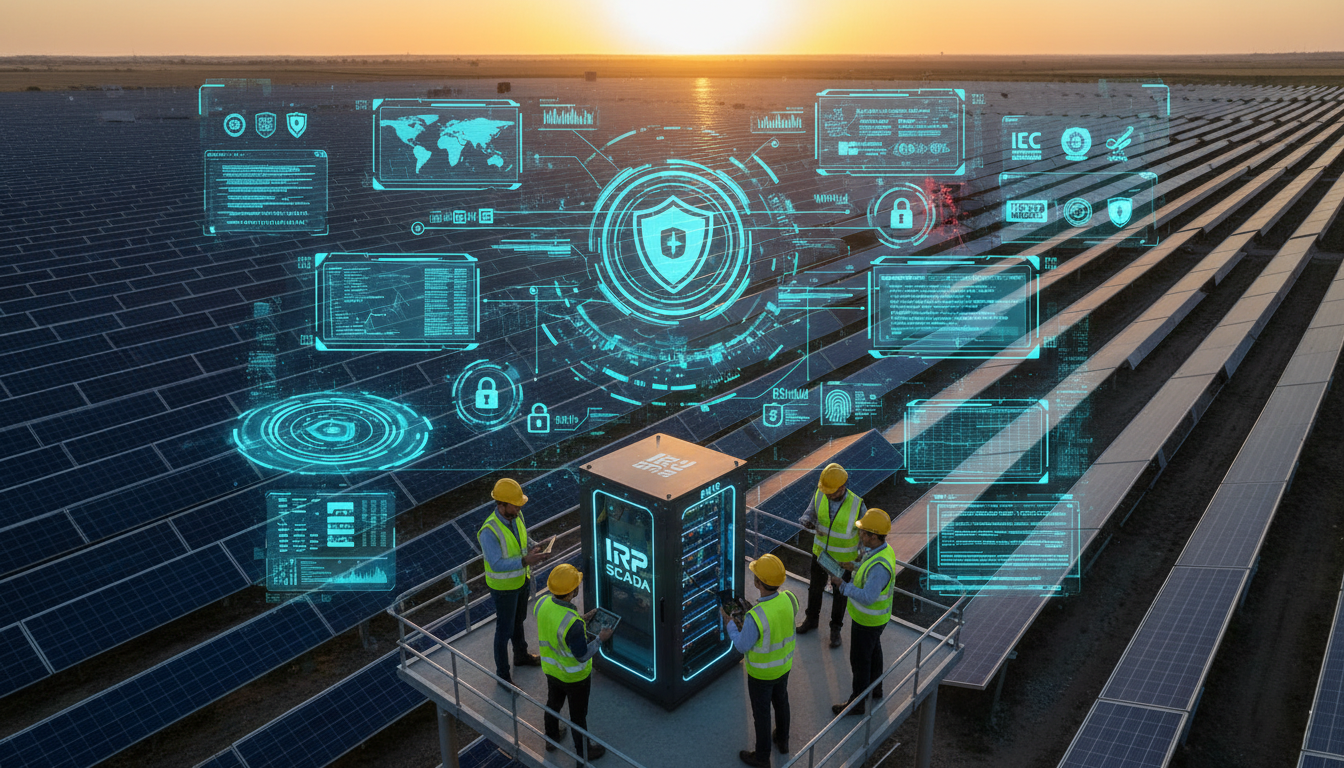
As renewable energy becomes central to the global power mix, the systems that operate and
control these assets have become critical to national infrastructure. Solar power plants today
are not isolated fields of panels; they are complex digital ecosystems — interconnected,
automated, and remotely managed.
At the heart of this ecosystem lies SCADA (Supervisory Control and Data Acquisition) — the
platform that monitors, commands, and balances every operational aspect of a plant. But as the
digital control of physical assets increases, so does the risk. The very connectivity that enables
efficiency also creates new vulnerabilities.
Protecting SCADA systems is no longer just an IT responsibility — it is a matter of energy
security
Why SCADA Security Matters More Than Ever
A SCADA system serves as the operational nerve center of any solar power plant. It collects
real-time data, executes grid commands, and enables remote control of critical equipment. A
single breach in this network can compromise generation, disrupt grid stability, or in extreme
cases, cause financial and reputational damage to operators.
As plants grow in size and as more assets connect through cloud platforms, the attack surface
widens. Cyber threats targeting industrial systems once rare have become increasingly
sophisticated. From malware designed to manipulate data to ransomware that halts control
operations, the threats are evolving faster than ever.
This makes SCADA cybersecurity a fundamental part of solar plant design, not an
afterthought.
Building Security by Design
At Infrared Power, security begins at the architecture level. Modern SCADA systems must be
built with defense-in-depth, a layered approach that protects data and operations at every level from field devices to the cloud.
Key design principles include:
- Network Segmentation: Separating control networks from administrative or public
networks to prevent unauthorized access. - Encryption: Ensuring that every communication link between sensors, data loggers,
and control servers is encrypted using industry-standard protocols. - Role-Based Access Control (RBAC): Granting users only the permissions necessary
for their responsibilities, minimizing internal vulnerabilities. - Audit Trails and Logging: Maintaining real-time records of every command and data
exchange for traceability and compliance. - Redundant Architecture: Ensuring operational continuity even during network
interruptions or cyber events.
When implemented effectively, these measures create a secure operational environment where
data integrity and availability are never compromised.
Compliance with Global Cybersecurity Standards
Cybersecurity is not just about protection it’s about compliance and accountability. Infrared
Power’s SCADA architecture aligns with international standards and frameworks including:
- IEC 62443: The global benchmark for industrial automation and control system security.
- ISO 27001: Information security management best practices.
- NERC CIP (North American Electric Reliability Corporation Critical Infrastructure
Protection): Guidelines for critical energy infrastructure.
By adhering to these frameworks, operators ensure that their plants meet the highest
benchmarks for security, reliability, and resilience not just locally, but globally
Cloud Connectivity Without Compromise
Modern SCADA systems increasingly rely on cloud-based dashboards for remote monitoring.
While this improves accessibility, it also demands advanced security measures. Infrared Power
integrates secure cloud gateways, VPN-encrypted communication, and two-factor
authentication (2FA) to ensure that remote access never comes at the cost of control.
Our systems employ end-to-end encryption between field devices and cloud servers, ensuring
that data remains untampered and confidential. Regular firmware updates and intrusion
detection mechanisms add further layers of protection, making IRP SCADA both intelligent and
secure.
The Future of Secure Solar Operations
Cybersecurity will define the next phase of digital transformation in renewable energy. As grids
become smarter and plants more connected, the boundary between IT (Information Technology)
and OT (Operational Technology) will blur demanding unified, proactive security strategies.
Infrared Power is committed to this future. Our SCADA solutions are designed not only to
optimize plant performance but to safeguard the integrity of the energy systems that power
our world. Because in the era of digital energy, resilience begins with security.
The future of solar operations depends on trust trust in data, in systems, and in the
technology that powers the transition to clean energy. SCADA security ensures that this
trust is never compromised
